
Chris Killip did not photograph a world of spectacle, but a world slowly disappearing. And that is precisely why his work lingers, like wet paint on a freshly painted wall: you cannot ignore it, you have to look. What I admire about him is his uncompromising style. No embellishment, no rush, no chase for the perfect image in search of applause. Only attention, time, and an almost stubborn devotion to the truth of the moment.

The power of simplicity and honesty
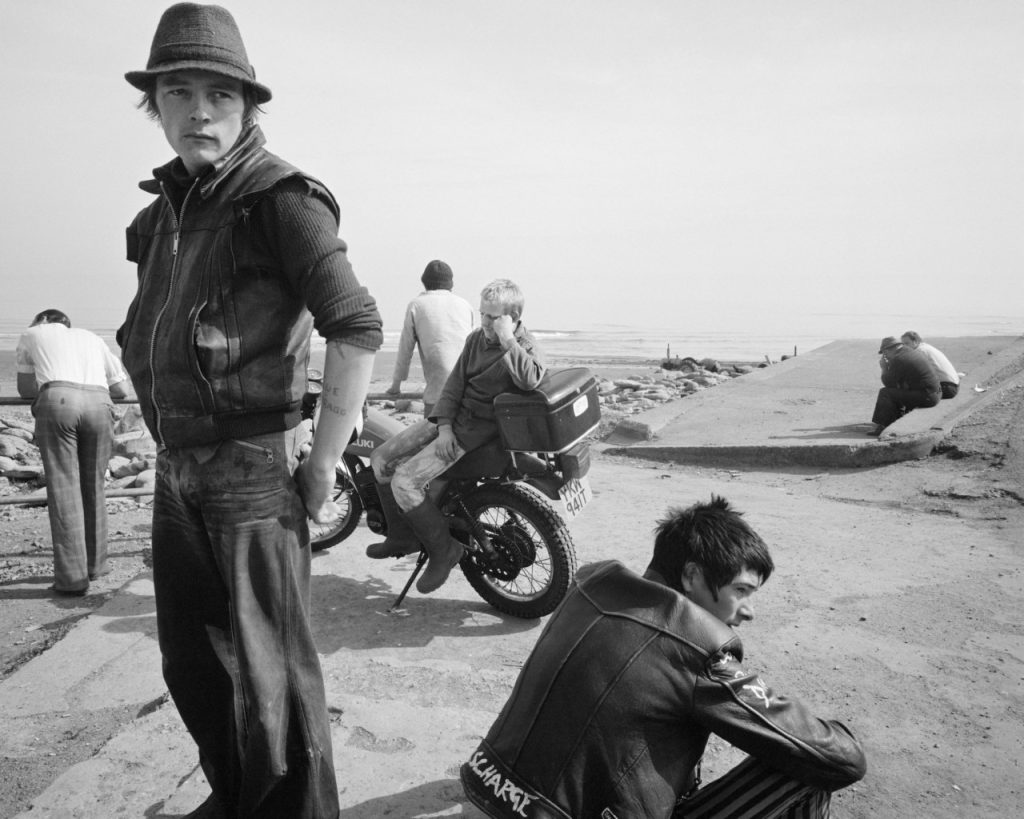
Killip worked primarily in black and white, though it is perhaps better described as emotional colour without colour. His images feel heavy, raw, and honest. He photographed communities in Northeast England during the industrial decline of the 1970s and 1980s. Not quick snapshots, but photographs born from long-term involvement. In many ways, he lived among his subjects, waiting, observing, and allowing the image to come to him.
What set him apart was that he did not photograph about people, but with people. You can see it. His photographs never feel like observations from the outside, but like a view from within. As if you are standing on that cold dock yourself, feeling the wind cut through your coat while, somewhere nearby, a child plays among rubble and hope.
Three factors that shaped his style
Three facts about Chris Killip clearly illustrate how he shaped his photographic style. First, he published the book In Flagrante in 1988. It is widely regarded as one of the most important photobooks in social documentary photography. The book is not a loose collection of images, but a carefully constructed visual narrative. He achieved this by dedicating years to a single, cohesive project, refusing to be distracted by trends or commercial pressure. His determination lay in his patience. Where many photographers might have stopped or moved on to something new, he kept digging into the same story until it felt complete.
Second, Killip was largely self-taught. He did not begin his career as a classically trained photographer, but developed his style through doing, observing, and reflecting. He initially worked as an assistant to a commercial photographer, but consciously chose an entirely different path. No gloss, but grit. He achieved this by remaining faithful to what genuinely interested him, even when it was less financially rewarding. His determination showed in making choices that were not necessarily easy, but deeply authentic.
Third, he eventually moved to the United States, where he taught at Harvard University. There, he influenced a new generation of photographers through his vision of commitment and integrity in photography. He achieved this not only by showing his work, but by passing on his way of seeing. His determination lay in sharing his convictions without softening or simplifying them.
Magnum Photos and Independence
An interesting chapter in his career is his relationship with Magnum Photos. In the 1980s, Killip was nominated as an associate member of Magnum, a collective renowned for its strong documentary tradition. Although he never became a full member, the nomination itself reflects the recognition his work received at the highest level of the photography world. According to Magnum Photos, Killip was valued for his in-depth, long-term projects and his commitment to social documentary photography. The fact that he never fully became part of the collective seems to fit his character perfectly: independent, strong-minded, and not easily shaped by institutional frameworks.
What we can learn from his way of seeing
What can we, as contemporary photographers, learn from Chris Killip? Perhaps the most important lesson is this: slow down. In a time when images are produced faster than coffee is brewed, Killip invites us to linger a little longer. Not only physically, but mentally as well. Look longer. Wait longer. Ask yourself what is really happening in a scene, beyond the first image.
In addition, he teaches us the importance of engagement. Not as a technique, but as a foundation. If you photograph someone, invest time. Get to know the context. Understand what you are looking at. Killip’s work shows that powerful photography does not emerge from distance, but from closeness.d.
Composition also plays a role, but with Killip it never feels forced. His images are carefully constructed, yet never sterile. There is a kind of controlled chaos within them. Lines, shapes, and people fall perfectly into place, but without ever feeling staged. That is a balance you can only achieve by looking deeply, and feeling even more deeply.
Seeing through Killip’s eyes
Seeing through the eyes of Chris Killip means accepting that not every image needs to be beautiful in the traditional sense. In fact, beauty often resides in discomfort. In the rough edges. In moments that remain unpolished.
If you want to apply his approach to your own photography, start small. Choose a subject close to home. Keep returning. Photograph not only what you see, but what you begin to understand. Let the story unfold slowly, just as Killip did.
His work does not whisper quick answers, but asks better questions. And perhaps that is the greatest lesson of all: photography is not a sprint toward perfection, but a walk through meaning. With mud on your shoes and a camera that only clicks when something truly matters.
Source: magnumphotos.com