
In the world of street photography, few names resonate as profoundly as that of Vivian Maier — a woman whose work was almost entirely unknown during her lifetime but has since reshaped how many of us see streets, strangers, and the poetry in the everyday. Maier’s story is at once inspiring, mysterious, and deeply human — and it’s one reason why I, as a street photographer, continue to chase the fleeting whisper of the decisive moment.
Vivian Maier (1926–2009) was an American photographer who spent decades photographing the streets of cities like Chicago and New York, creating more than 150,000 images without ever showing them to the world. Her photography remained hidden until after her death, when a Chicago collector named John Maloof accidentally purchased a box of her negatives at auction and began to share the work online.
What makes Maier’s work unique isn’t just the sheer volume of her photographs, but the quality of her vision. She wandered urban landscapes for over forty years, capturing people in moments of unguarded grace, humor, struggle, solitude, and introspection. Her compositions balance intuitive formal awareness with raw humanity, drawing the viewer into scenes that feel both specific and timeless. Maier’s images reveal the human condition with empathy and curiosity — strangers rendered not as subjects but as silent companions in shared experience.
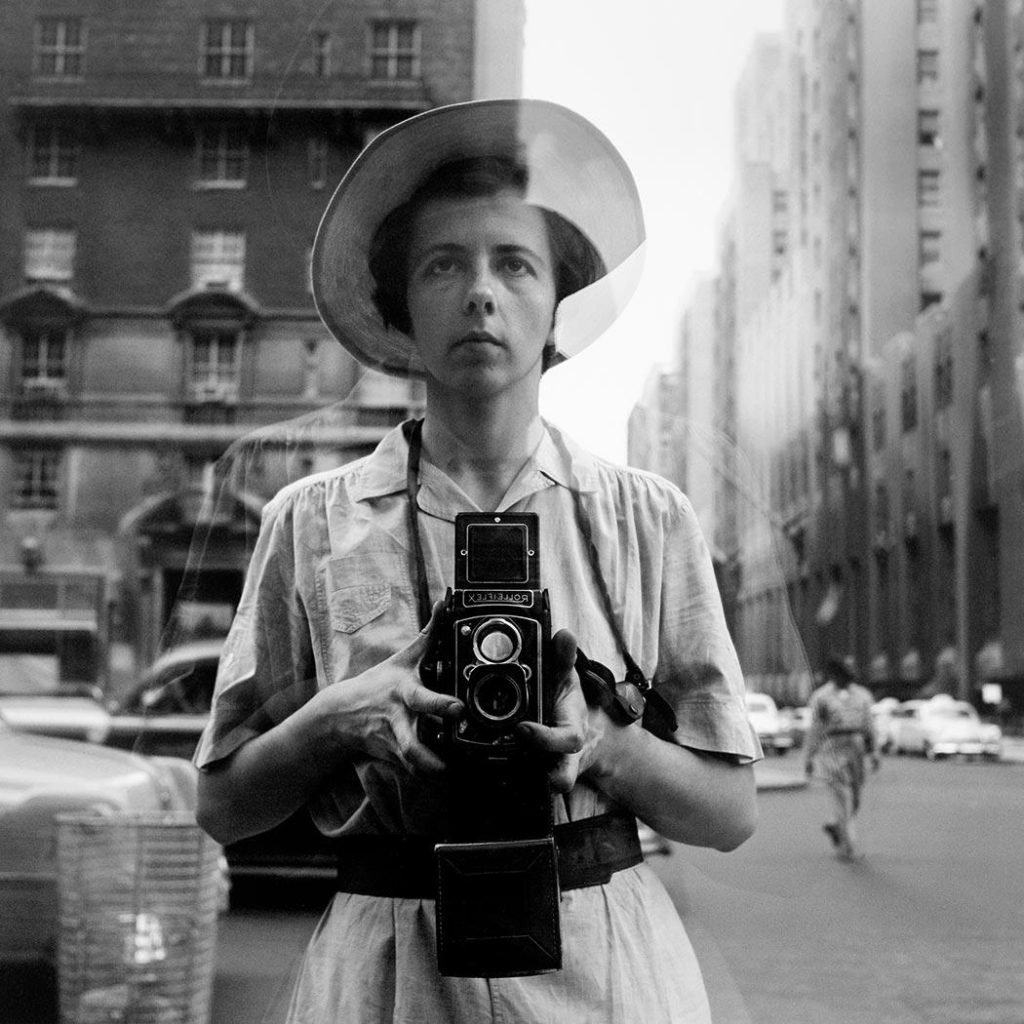
Her approach was deeply personal. Maier carried her Rolleiflex twin-lens reflex camera everywhere, often photographing from the chest, inviting spontaneous moments into view without disruption. Her body of work spans humor and tenderness, beauty and grit, light and shadow — but always with an unmistakable curiosity about people and their stories. It’s this blend of presence and curiosity that resonates so deeply with me.
For me, street photography is about bearing witness, much like Maier did — seeing the world not as a sequence of events to be documented, but as moments of life unfolding in real time. There is something profoundly moving about capturing a moment that will never come again, a gesture that flickers and passes like breath. Maier’s legacy reminds me that every street is a stage, every face a narrative, and every click a fragile testament to time itself.
The Documentary That Changed How I See Her
The 2013 documentary Finding Vivian Maier, written and directed by John Maloof and Charlie Siskel, was a revelation for me. The film traces Maloof’s discovery of her work and attempts to uncover the life behind the images. It presents not just her photographs, but also the people who knew her — the families she worked for as a nanny — revealing a woman both fascinating and, at times, difficult. This complexity, woven into the narrative of her art, left a deep impression on me.
What struck me most was the contrast between Maier the person and Maier the photographer. Here was someone who saw the world with extraordinary sensitivity yet lived in quiet isolation. The documentary shows her work in rich detail but also grapples with the irony that someone capable of such profound empathy through her images could be so private, so unknowable in life. By the end, you feel admiration and frustration — admiration for her vision, and frustration at the mystery that remains.
For photographers like me, this story is a powerful reminder: art can outlive its creator, but it also carries the imprint of their complexity, contradictions, and humanity. Vivien Maier’s legacy isn’t just about the photographs she made — it’s about the way she looked. And that, for me, is the heart of street photography.
Source:
https://en.wikipedia.org/wiki/Vivian_Maier
https://www.artsy.net/article/artsy-editorial-vivian-maiers-street-photography
https://www.vivianmaier.com/film-finding-vivian-maier